
Build knowledge from your documents.
Turn the documents you already have into structured knowledge your assistant can answer from — you always review it before it goes live.
What it does #
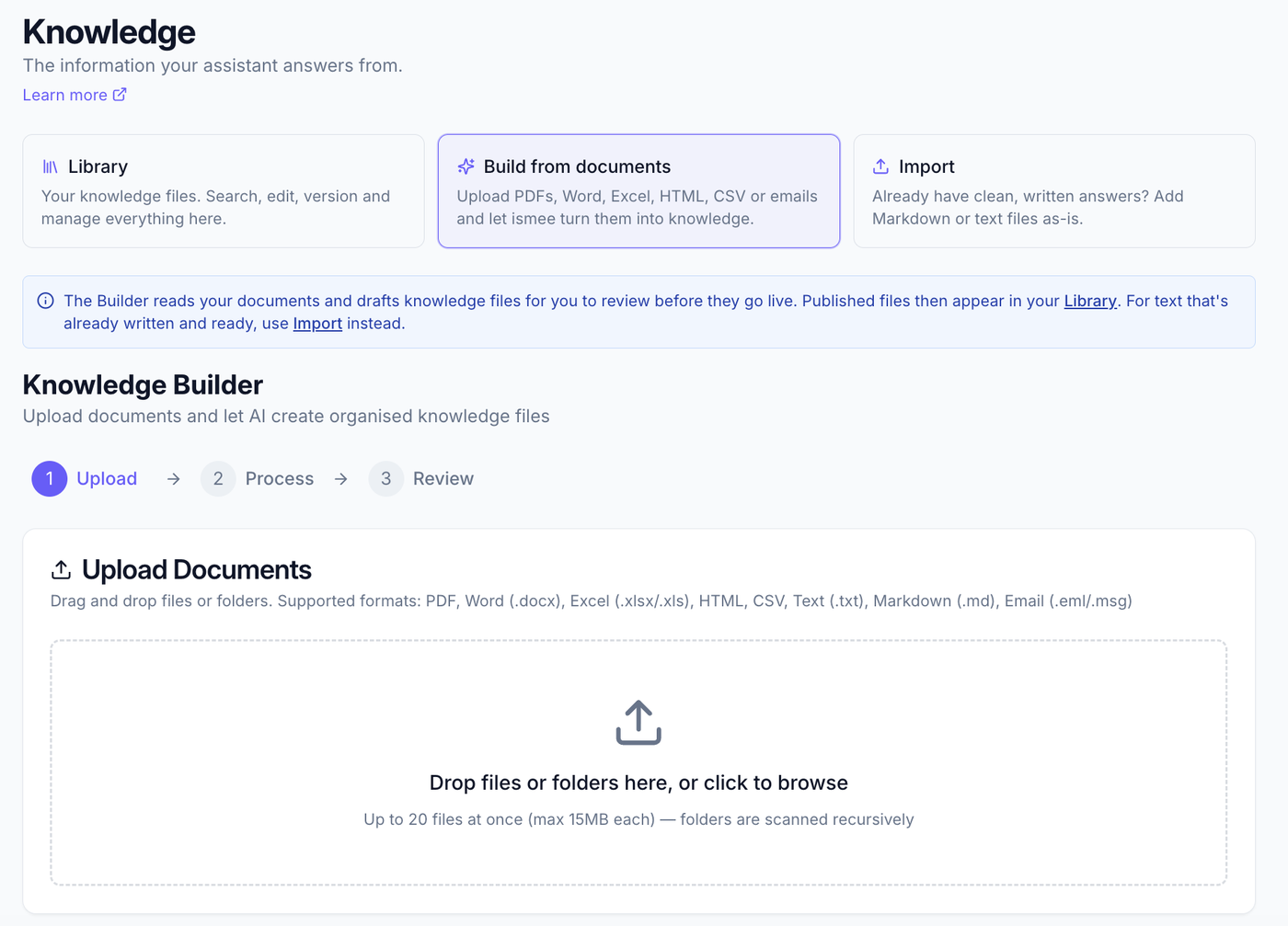
The Knowledge Builder reads your documents, finds the themes, and drafts structured knowledge. Nothing goes live until you've reviewed and approved it — so you stay in control of what your assistant knows.
Supported files #
Drag in up to 20 files at once (max 15 MB each), or drop a whole folder — folders are scanned recursively and unsupported files are skipped.
Already have a ready-made answer written in Markdown or plain text? Add it as-is with Import instead.
Build in three steps #
- Upload. Go to Your assistant → Knowledge → Build from documents. Drag your files in (or click to browse) and choose Process files.
- Process. ismee analyses your documents — identifying themes, picking up the writing style, and pulling out the important information. This takes a few minutes.
- Review. Check each draft, edit anything that needs it, then Approve to add it — or Reject what isn't right.
Getting emails in #
ismee accepts email files directly — .eml and .msg — so you can drag them straight into Build from documents. If you'd rather, you can also save an email as a PDF first. Here's how to get them out of the common apps:
- Outlook (desktop): open the email → File → Save As → choose Outlook Message Format (.msg) or HTML. Or File → Print → Save as PDF.
- Outlook Online (OWA): open the email → ••• (More actions) → Print → Save as PDF.
- Gmail: open the email → ⋮ menu → Show original → Download original for a .eml; or ⋮ → Print → Save as PDF.
Smart merge #
When new content overlaps knowledge you already have, ismee offers a choice:
- Merge — combine the new content with the existing file.
- Replace — overwrite the existing content with the new version.
- Keep separate — add it as a new file.
The Library #
Approved knowledge lives in the Library — the default view under Knowledge. From there you can search, edit, version and manage your files any time.
Tips #
- Quality in, quality out — start with well-structured source documents.
- Review thoroughly — always check the drafts for accuracy before approving.
- Group related documents together in a batch.
- Re-process a document when it changes so your knowledge stays current.
What to read next #
- Importing knowledge — add ready-made Markdown or text as-is.
- Knowledge insights — see coverage, gaps and what's used.
- Getting started — the full setup path.