See what your assistant knows — and what it doesn't.
Knowledge insights show where your knowledge is strong, where the gaps and conflicts are, and which knowledge is actually being used.
Coverage #
Open Insights → Knowledge insights. Coverage shows how strong your knowledge is across different areas — so you can see at a glance where your assistant is well-equipped and where it's thin.
Gaps #
Gaps are questions your assistant couldn't answer confidently from your knowledge. They're the clearest signal of what to capture next.
Conflicts #
Conflicts flag where your sources disagree — catching contradictions between documents before your team runs into them. Review each one and fix the source, so answers stay consistent.
The utilisation panel #
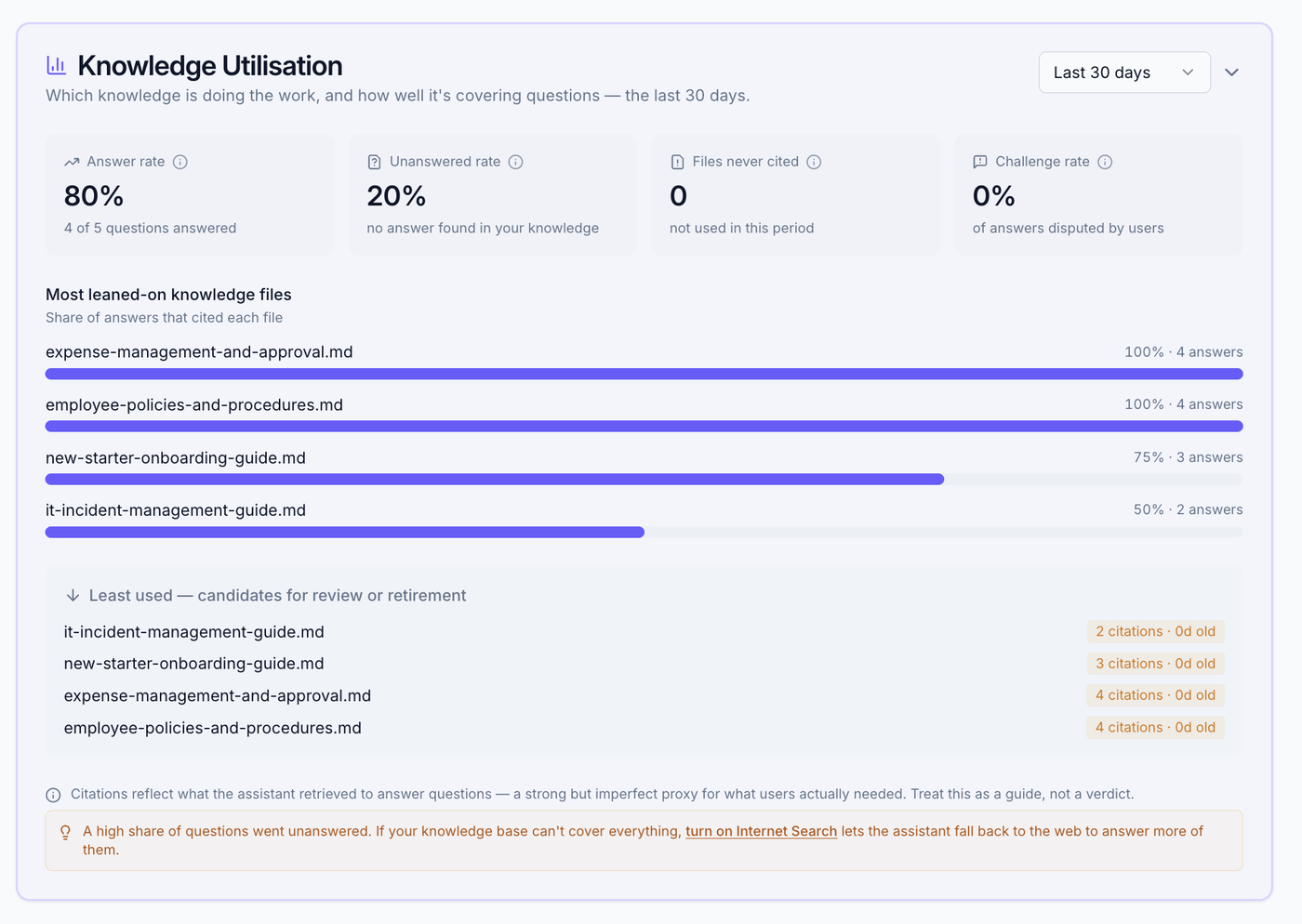
At the top of Knowledge insights, the Knowledge Utilisation panel shows which knowledge is actually doing the work, not just where the gaps are:
- Answer rate — how often questions get a confident answer.
- Web-search reliance — the share of answers that needed the internet. A falling figure over time means your knowledge base is closing its own gaps.
- Files never cited — knowledge that isn't being used in the period.
- Challenge rate — how often answers are questioned.
Below the tiles: a chart of the most leaned-on files and a least-used list, with a period selector (7 / 30 / 90 days / all time).
Acting on insights #
- Use gaps to decide what knowledge to add next.
- Review least-used files — retire or improve dead weight.
- If web-search reliance is high, either add knowledge to fill the gap or turn on Internet search.
What to read next #
- Adding knowledge — fill the gaps you find.
- Internet search — let the assistant use public information.